
Behind the smooth surface of an automobile dashboard, the delicate texture of a laptop shell, or the pristine transparency of medical equipment lies an unseen “temperature commander”—the mold temperature controller. While it does not directly participate in production, it determines the success or failure of quality for every molded, die-cast, or chemical product. Let’s unveil the mystery of this critical equipment in the industrial field.
1. What is a Mold Temperature Controller? Unveiling the Core Principle
A mold temperature controller, formally known as a mold temperature control unit, is a professional temperature regulation device that dynamically adjusts the working temperature of molds or equipment by heating, cooling, and precisely circulating a heat transfer medium (typically water or thermal oil).
Its working principle can be summarized as an intelligent closed-loop system:
(1). Sensing & Monitoring: Built-in temperature sensors detect the actual mold temperature in real-time.
(2). Intelligent Comparison: The control system compares the detected value with the preset process temperature.
(3). Precise Adjustment: If the temperature is low, it activates the heater to warm the circulating medium; if the temperature is high, it activates the cooling system (typically connected to a cooling tower or chiller).
(4). Circulation & Delivery: A high-pressure pump forces the adjusted medium to circulate through the network of pipes inside the mold, enabling efficient heat exchange.
This process operates continuously in cycles of seconds, ensuring the mold temperature remains stable within a narrow range of ±0.5°C or even tighter, as required by the process.
2. More Than Just a “Heater”: The Key Roles of Mold Temperature Controllers
Many mistakenly believe mold temperature controllers are simple heating devices. In reality, they play multi-dimensional critical roles in modern manufacturing:
(1). The Quality Guardian
In injection molding, stable mold temperature significantly reduces product defects: preventing sink marks, flow lines, and warpage, ensuring consistent dimensional accuracy, and improving surface finish.
In composite material molding, precise heating curves and temperature maintenance are essential for complete resin curing.
(2). The Efficiency Accelerator
– Preheating molds drastically reduces warm-up time at the start of production.
– Optimizing the cooling process shortens product cycle times, potentially increasing output by over 30%.
(3). The Cost Controller
– Reduces scrap rates, directly lowering material waste.
– Stable process conditions extend mold service life, reducing maintenance costs.
– Energy-efficient designs in modern controllers can save 20-40% energy compared to traditional heating methods.
(4). The Process Enabler
– Enables complex processes: Such as Rapid Heat Cycle Molding (RHCM) technology, which uses the controller for rapid mold surface temperature cycling to produce high-gloss, weld-line-free plastic appearance parts without additional coatings.
– Adapts to new materials: The application of new materials like high-performance engineering plastics and biodegradable materials demands higher temperature control precision, making mold temperature controllers indispensable.
3. Technological Evolution: From Mechanical Control to Smart IoT
Mold temperature controller technology has evolved through several generations:
– First Generation: Simple mechanical control, low precision, poor stability.
– Second Generation: PID (Proportional-Integral-Derivative) control became standard, significantly improving precision.
– Third Generation: Integrated PLC (Programmable Logic Controller) enabled multi-stage temperature curve programming for complex processes.
– Fourth Generation (Current Mainstream): Features touchscreen HMIs, self-diagnosis, remote monitoring, with some models integrating IoT modules.
– Cutting-Edge Development: AI-based temperature predictive control, energy efficiency optimization algorithms, deep integration with plant-wide MES (Manufacturing Execution Systems) for predictive maintenance and full-process energy management.
4. Selection Guide: How to Choose the Right Mold Temperature Controller?
Selecting a mold temperature controller requires comprehensive consideration of several factors:
(1). Temperature Range & Precision
– Water Temperature Controller: Typically suitable for 30°C-180°C, precision up to ±0.5°C
– Oil Temperature Controller: Can reach above 350°C, precision ±1°C
– Choose based on material process temperature requirements.
(2). Heating & Cooling Capacity
– Heating power (KW) must match mold heating speed and heat loss.
– Cooling capacity must be sufficient to remove heat generated during the molding process.
(3). Pump Performance
– Flow rate and pressure must overcome mold coolant channel resistance to ensure adequate circulation.
(4). Control System
– Choose control functions based on process complexity.
– Consider future upgrade and networking needs.
(5). Safety & Energy Efficiency
– Multiple safety protections (overtemperature, media loss, overload, etc.).
– Evaluate energy efficiency rating for significant long-term energy savings.
5. Panorama of Industry Applications
Mold temperature controller applications have permeated various manufacturing sectors:
– Plastics Molding: Injection molding, blow molding, extrusion, thermoforming.
– Rubber Products: Vulcanization molding.
– Composite Materials: SMC/BMC molding, carbon fiber molding.
– Die Casting: Aluminum alloy, magnesium alloy die casting.
– Chemical & Pharmaceutical: Reactor temperature control.
– New Energy: Battery separator production, fuel cell component manufacturing.
– Printing & Packaging: Roller temperature control.
Conclusion
In the context of smart manufacturing and high-quality development, mold temperature controllers have evolved from auxiliary equipment to core process machinery. Like a tireless, precise commander on the unseen battlefield of temperature, they ensure the perfect birth of every product. As Chinese manufacturing advances towards high-end production, the demand for precise process control will continue to grow, further highlighting the value of this “temperature artist.” Whether for upgrading traditional industries or achieving breakthroughs in new industrial processes, precise temperature control will be a key link in the quality revolution.
Choosing and utilizing mold temperature controllers well is not just an investment in equipment but a strategic investment in product quality, production efficiency, and process capability. In this era of micron-level competition, mastering temperature means mastering quality.
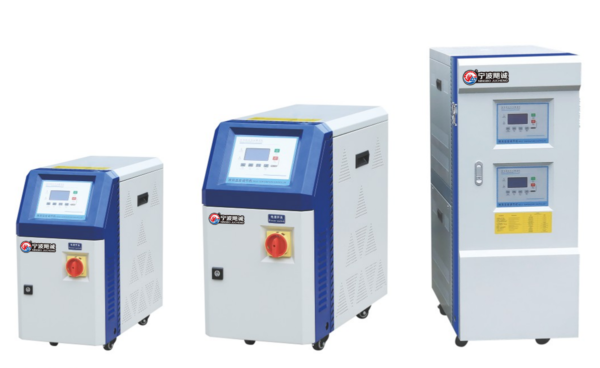
Water-based mold temperature controller
180°/300° (high temperature) oil-based mold temperature controller
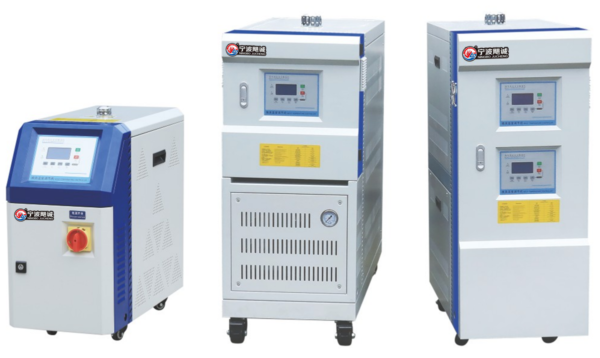
Oil-based mold temperature controller
Heat Transfer Medium:
Using high-temperature heat transfer oil as the circulating medium, it provides uniform temperature rise, higher operating temperature, and precise temperature control (blow-off oil return is optional).
Safety Protection:
Features include automatic audible and visual alarm and shutdown in case of malfunction, automatic shutdown and cooling in case of over-temperature, power phase loss and reverse phase protection, oil shortage protection, and heat transfer pump overload protection.
Application Industries:
Automatic temperature control for injection molding, printing, reaction vessels, rubber, rollers, extrusion, die casting, material drying and conveying, and other industries!