
In modern industrial production, precise temperature control is crucial for ensuring product quality, improving production efficiency, and guaranteeing equipment stability. Whether it’s plastic injection molding, laser cutting, chemical reactions, or biopharmaceutical processes, a reliable cooling system is essential. Among these systems, the Air-Cooled Industrial Chiller has become the preferred cooling solution in numerous industrial fields due to its unique advantages.
1. What is an Air-Cooled Industrial Chiller?
An air-cooled industrial chiller is a complete refrigeration cycle system. Its core working principle is to use the phase change of refrigerant (evaporation absorbs heat, condensation releases heat) to remove heat generated by process equipment or during production.
The simplified workflow is as follows:
(1). Heat Absorption: Low-temperature, low-pressure liquid refrigerant enters the evaporator, where it exchanges heat with the circulating water (or glycol solution) from the user’s side. It absorbs heat from this fluid, evaporates into a gas, thereby cooling the circulating medium.
(2). Compression: The low-temperature gaseous refrigerant is sucked in and compressed by the compressor, becoming a high-temperature, high-pressure gas.
(3). Heat Dissipation (The Key “Air-Cooled” Step): The high-temperature, high-pressure refrigerant gas enters the condenser. The air-cooled unit uses fans to force ambient air over the condenser coils, carrying away the refrigerant’s heat, causing it to cool and condense back into a high-pressure liquid. This is the most fundamental difference from water-cooled units.
(4). Expansion: The high-pressure liquid refrigerant passes through an expansion valve (or capillary tube), where it throttles and returns to a low-temperature, low-pressure liquid state before re-entering the evaporator to start the next cycle.
2. Core Advantages of Air-Cooled Industrial Chillers
Compared to water-cooled chillers (which require a cooling tower and cooling water system), the air-cooled design offers several irreplaceable benefits:
(1). Easy Installation, Saves Space and Infrastructure Costs:
No cooling tower, water pump, or complex piping systems are needed. Simply connect to power and the process cooling pipes to operate.
Saves the rooftop or outdoor space required for a cooling tower, making it especially suitable for sites with space constraints, water scarcity, or where installing a cooling tower is impractical.
(2). Zero Water Consumption, Eco-Friendly and Energy-Efficient:
Relies entirely on air for heat dissipation, consuming no process water. This is a significant advantage in areas with high water costs or strict water conservation requirements.
Avoids issues like scale buildup and algae growth common in cooling water systems, reducing the cost and complexity of water treatment.
(3). Independent System, High Reliability:
The integrated, standalone design is not affected by external cooling water system failures (e.g., cooling tower malfunctions, pipe bursts), leading to more independent and stable operation.Eliminates the risk of cooling water freezing in winter or low-temperature environments.
(4). Portable and Flexible Layout:
Units can be flexibly installed on workshop floors, platforms, rooftops, or even designed as mobile units, making them easy to relocate as production lines change.
3. Wide Range of Applications
Air-cooled industrial chillers are used in almost every industry requiring process cooling:
Plastics Industry: Cooling for injection molding machines, blow molders, and extruders to shorten cycle times and ensure product solidification.
Laser Processing: Efficient cooling for laser heads, optical lenses, and power supplies of CO2, fiber, and UV lasers to ensure beam quality and equipment lifespan.
CNC Machining & Metal Cutting: Cooling spindles and cutting fluids to ensure machining precision and extend tool life.
Chemical & Pharmaceutical: Temperature control for reactors, distillation condensers, and bioreactors.
Food & Beverage: Cooling production equipment and enabling rapid cooling for forming processes.
Electroplating & Anodizing: Cooling electrolyte solutions to ensure plating quality.
Laboratory Equipment: Cooling for precision instruments like MRI machines, electron microscopes, and rotary evaporators.
4. Key Considerations for Selection and Use
Choosing the right chiller is crucial for system performance. The following factors must be considered:
(1). Cooling Capacity: Calculate based on the heat load of the equipment to be cooled (usually in kW or kcal/h), including a 10%-20% safety margin.
(2). Ambient Temperature & Ventilation:
The heat dissipation efficiency of an air-cooled chiller is directly affected by ambient air temperature. High ambient temperatures or poor ventilation in the equipment room can lead to increased condenser pressure, reduced cooling efficiency, and even alarm shutdowns.
It is essential to ensure the installation site has excellent ventilation, with no obstructions at the air intake and exhaust outlets. Air ducts or forced exhaust may be necessary in some cases.
(3). Noise Considerations: Fan operation generates noise. For installations near offices or noise-sensitive areas, select low-noise models or implement soundproofing measures.
(4). Dust Protection & Maintenance:
Condenser fins easily accumulate dust and debris, requiring regular cleaning (recommended quarterly inspection). Neglecting this severely impacts heat dissipation and increases energy consumption.
Perform regular checks on the operational status of the compressor, fans, pumps, and refrigerant pressure.
Conclusion
With their flexible installation, water-saving eco-friendliness, and relatively simple maintenance, air-cooled industrial chillers hold a solid position in the modern industrial cooling market. For most factories with small to medium cooling demands, water restrictions, or a need for rapid deployment, they represent an efficient, reliable, and economical choice. Proper sizing, strategic placement for airflow, and a consistent preventive maintenance schedule are the keys to ensuring the long-term, stable, and optimal performance of an air-cooled chiller.
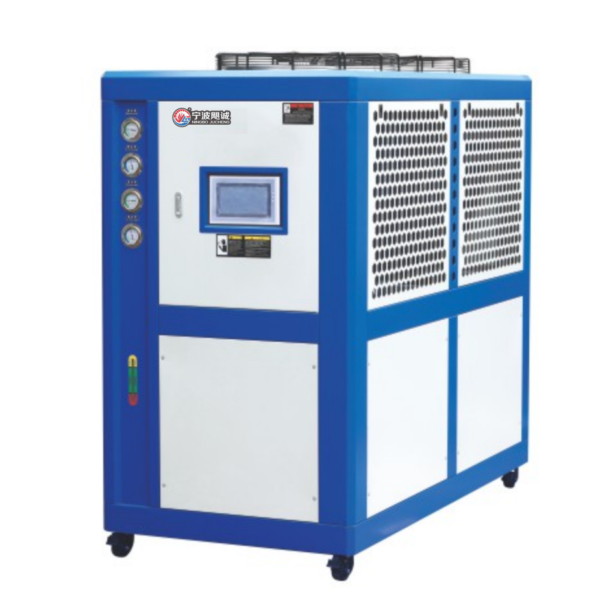
Air-cooled modular chiller
The casing utilizes 3D design, featuring an overall European-style modular and detachable structure. The surface is treated with polyester powder coating, resulting in an aesthetically pleasing appearance with excellent color fastness and corrosion resistance.
Cooling conditions: Chilled water inlet/outlet temperature 12/7℃; ambient temperature 35℃;
N: Number of unit modules;
BKM-065A*N is available with sensible heat recovery function, sensible heat recovery capacity 15KW, outlet water temperature 45℃, pipe connection size DN25;