
Introduction: The Reliable Pillar of Large-Scale Cooling
In injection molding workshops, precision manufacturing plants, or data centers with enormous power consumption, when cooling demands exceed the limits of air-cooled systems, a more powerful, efficient, and stable system quietly takes the stage—this is the Industrial Water-Cooled Chiller. Serving as the “cooling heart” of modern large-scale industrial facilities and commercial buildings, water-cooled chillers support continuous, high-load production operations with their exceptional energy efficiency and stable performance.
1. Core Principle: The Fusion of Classic Refrigeration Cycle and Water-Cooled Heat Dissipation
The refrigeration core of a water-cooled chiller is the same as that of an air-cooled unit, both following the vapor-compression refrigeration cycle (evaporation-compression-condensation-expansion). The key difference lies in the critical heat dissipation stage.
Simplified Workflow:
(1). Evaporator Absorbs Heat: Low-temperature liquid refrigerant absorbs heat from the chilled water (supplied to end-use equipment) inside the evaporator, evaporating into a low-temperature gas.
(2). Compressor Work: The compressor compresses this gas into a high-temperature, high-pressure superheated vapor.
(3). Condenser Dissipates Heat (The Water-Cooled Core): The high-temperature refrigerant enters the condenser. Unlike air-cooled units, what flows through the condenser tubes here is cooling water from the cooling tower. The cooling water carries away the refrigerant’s heat, causing it to condense into a high-pressure liquid. The heated cooling water is then pumped to the cooling tower for heat dissipation.
(4). Expansion and Pressure Reduction: The high-pressure liquid refrigerant passes through an expansion valve, where it throttles and returns to a low-temperature, low-pressure state before re-entering the evaporator, completing the cycle.
The System Triangle: Chiller Unit + Cooling Tower + Cooling Water Pump
This forms a complete “water-to-water heat exchange” system. The chiller unit itself works in tandem with the cooling tower to accomplish the cooling task.
2. Why Choose Water-Cooling? Analysis of Core Advantages
Compared to air-cooled systems, water-cooled chillers offer decisive advantages in specific application scenarios:
(1). Higher Coefficient of Performance (COP), Significant Energy Savings
Core Advantage. Water has a much higher specific heat capacity than air, leading to extremely high heat transfer efficiency. This allows the refrigerant’s condensing temperature and pressure to be maintained at a more ideal, lower level. The compressor works against a lower pressure differential, significantly reducing power consumption. The COP is typically 20%-40% higher than that of a similarly sized air-cooled unit. For systems running continuously long-term, the savings on electricity costs are substantial.
(2). Excellent Stability and Environmental Adaptability
The cooling water temperature (typically wet-bulb temperature + approach) depends primarily on the ambient wet-bulb temperature, which is generally much lower and less variable than the ambient dry-bulb temperature (on which air-cooled units rely). Therefore, water-cooled chillers are far less affected by extreme summer heat than air-cooled units. They maintain high cooling capacity and stable operation even during hot seasons, without derating or alarming due to high temperatures.
(3). Ideal for Large Cooling Capacity Scenarios, Saves Floor Space
When the single-unit cooling demand exceeds 350 kW (approx. 100 refrigeration tons), the water-cooled solution shows clear advantages in cost and efficiency. Although it requires additional space for the cooling tower, the main unit itself is often more compact than an air-cooled unit of equivalent capacity. It can be installed in an indoor equipment room, protected from harsh outdoor weather, leading to a longer lifespan.
(4). Quiet Operation
The main noise source—the cooling tower—can be placed on the roof or away from noise-sensitive areas. The noise from the host unit inside the indoor equipment room is easier to control with soundproofing measures, providing a quieter environment for the factory or building.
3. Typical Application Scenarios
Water-cooled chillers are the preferred choice in the following high-load, continuous operation fields:
Large-Scale Industrial Manufacturing: Cooling for automotive plant welding/painting shops, large central air-conditioning systems.
Plastics Processing: Centralized cooling for multiple large injection molding machines or extrusion lines.
Data Centers: Precision air conditioning cooling for server racks, requiring year-round, uninterrupted, high-efficiency operation.
Chemical & Energy Industries: Cooling for large reactors, power plant auxiliary equipment, process gases.
Large Commercial Buildings: Central air-conditioning cold source for hotels, hospitals, shopping malls.
Biopharmaceuticals: Fermentation workshops and clean rooms requiring strict constant temperature and humidity.
4. Key System Components and Selection Considerations
(1). Core Components:
Compressor: Scroll, Screw (mainstream for medium/large capacities), Centrifugal (for very large capacities). Screw compressors are the industrial mainstream due to their high efficiency and long life.
Condenser: Shell-and-tube or plate heat exchanger, crucial for water-cooled heat dissipation.
Evaporator: Also often shell-and-tube or plate type, generating chilled water.
Cooling Tower: The “lungs” of the system, rejecting heat to the atmosphere through water evaporation. Types include Open Circuit (requires water treatment) and Closed Circuit (independent cooling water loop, cleaner).
(2). Key Points for Selection and Design:
Accurate Cooling Load Calculation: Must consider all heat sources, pipeline losses, and potential future expansion.
Cooling Tower Matching: The cooling tower’s heat rejection capacity must match the chiller’s condenser heat load, based on the local design wet-bulb temperature.
Water System Design: Includes two separate circulation systems (condenser water and chilled water). Requires professional hydraulic calculation to select appropriate pumps, valves, pressure maintenance, and filtration equipment.
Water Treatment is the Lifeline: A water treatment system (softening, filtration, chemical dosing) is essential to prevent scaling, corrosion, and biological growth (algae, legionella). Neglecting this will severely impair efficiency and damage equipment.
Decision Advice:
Choose Water-Cooled: When your facility has high electricity costs, requires 24/7 year-round operation, needs large single-unit capacity, or is located in an area with very high summer temperatures. The long-term energy savings of a water-cooled system will quickly offset its higher initial investment.
Choose Air-Cooled: When cooling demand is small, initial budget is tight, water is scarce, or installation space cannot accommodate a cooling tower. Air-cooled is a more flexible and simpler choice.
—
Conclusion
An industrial water-cooled chiller is not merely a piece of equipment; it is a precisely engineered system. By cleverly utilizing water—a highly efficient medium—for heat dissipation, it achieves unparalleled operational efficiency and stability, forming the cornerstone of modern large-scale industrial cooling. Although its initial investment and maintenance requirements are higher, for enterprises pursuing the lowest long-term operating costs and maximum production stability, the water-cooled chiller is undoubtedly the strategic investment with the highest return on investment. Successful application begins with professional design and quality components but equally depends on rigorous daily water treatment management and maintenance.
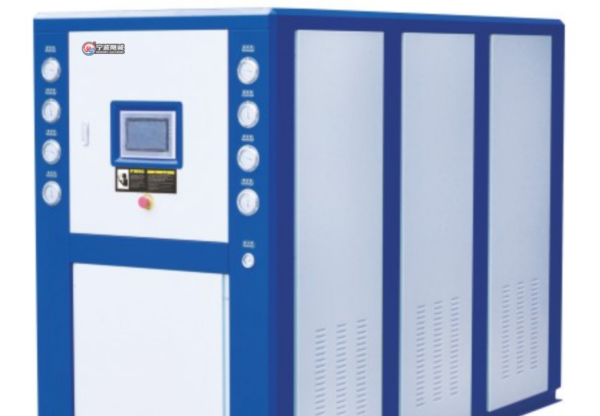
Water-cooled modular chiller
The design is simple and elegant; it uses a high-efficiency scroll compressor and a touch-screen human-machine interface operating system, making the unit easier to operate and understand. The system automatically adjusts the operating time of each component based on the compressor’s operating conditions; the entire system is optimally matched, resulting in excellent overall performance and extremely high cooling efficiency.