
With the widespread use of chillers, more and more users are choosing to purchase water-cooled chillers. Therefore, the editor of Jucheng Chillers has compiled the following analysis and summary of the installation of water-cooled chiller units, hoping to provide experience and reference for chiller users.
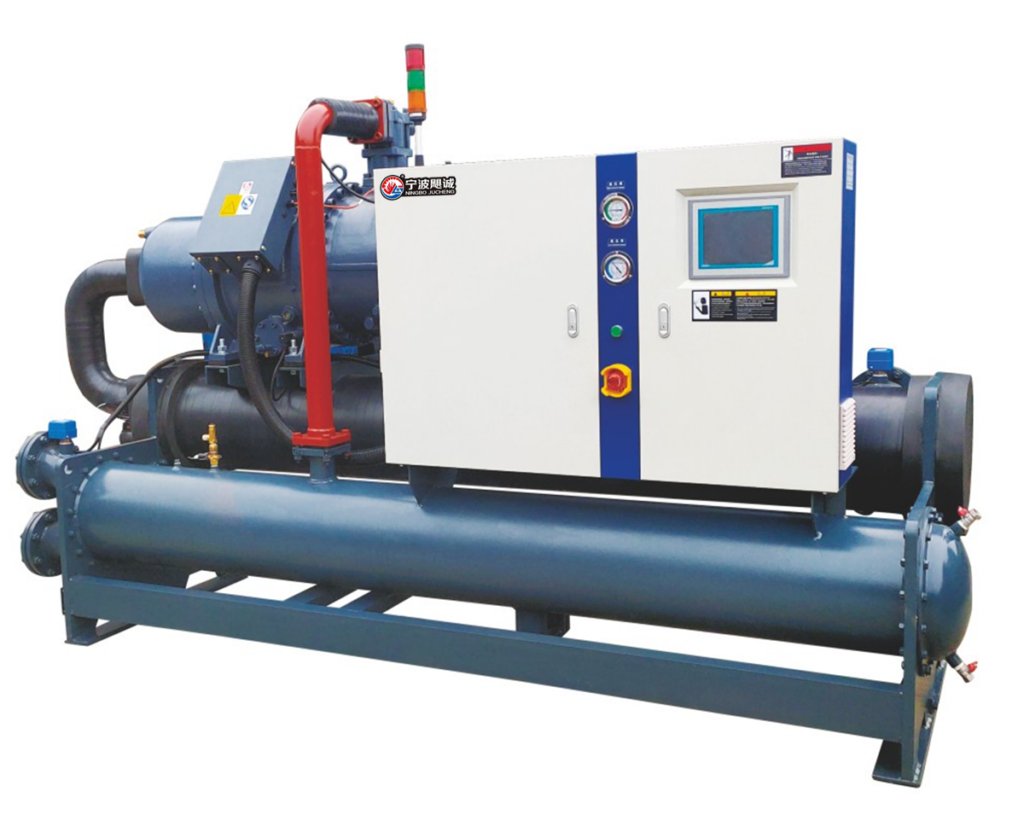
I. Installation of Water-Cooled Chiller Units (mainly foundation and vibration isolation equipment): When installing, a flat, open space should be selected, and chillers are no exception. Many customers will properly pour concrete for the foundation after installing the chiller, placing it on a four-level pad. Our chillers have four feet. Adjustable pads with two adjusting screw holes can be provided to adjust the chiller’s temperature, or concrete mortar can be used to fill the adjustment gaps.
II. Water Line Installation of Water-Cooled Chiller Units: This is mainly for the outside of the evaporator and condenser. If the water pipes are double-backed, they should be placed on the same side. If it is a single or triple return flow, it should be placed on both sides of the chiller unit, and the water entering and exiting the condenser and evaporator should move up and down. Therefore, the installation of water pipes should follow the installation diagram provided by the chiller unit.
III. Water Pipe Cleaning of Water-Cooled Chiller Units: After installation, the entire water system should be leak-tested. First, ensure that the pump is correctly positioned, then open all inlet and outlet valves. Fill all water pipes with water. Turn on the coolant pump and the cooling water pump. Keep operating for 2 hours. Stop the pumps. Drain all coolant and cooling water. Clean the pump filter.
IV. Insulation of Water-Cooled Chiller Units: Cooling loss occurs when the unit system temperature is lower than the ambient temperature. To reduce this loss, it is recommended that the low-temperature parts of the equipment and pipes be coated with insulation material. During the installation of the water-cooled chiller unit and system pressure testing, the evaporator casing or evaporator, compressor inlet pipe, and return pipe are used as insulation materials.
V. Water Source Requirements for Water-Cooled Chiller Units
- Water Flow. Since chiller units have different requirements for water flow, chiller operators should strictly control the water volume according to the specifications. If the water volume is too low, the operating efficiency of the air conditioning unit will decrease, and too much water will overload the chiller unit.
- Water Quality. If the water quality is poor, the air conditioning unit will generate a significant amount of scale and debris during operation. At the time, we requested Henan Huiyin, a professional central air conditioning service company, to clean it promptly to prevent pipe blockage.
- Water pH value. If the pH value is too high, it will corrode the pipe fittings, leading to irreversible damage to the water-cooled chiller unit and even causing it to shut down. Therefore, it is necessary to understand the local water pH value and choose neutral water.
In summary, the installation of a chiller reflects its cooling effect and the guarantee of maintenance and repair. The above is a summary of various aspects of water-cooled chiller unit installation, including pipe installation, cleaning, and insulation, compiled by the editor of Jucheng Chillers.