
A mold temperature controller, also known as a mold temperature control machine, encompasses both heating (temperature increase) and cooling (temperature decrease) functions, and is widely used for temperature control in industrial manufacturing.
Specifically, industrial mold temperature controllers offer five major advantages:
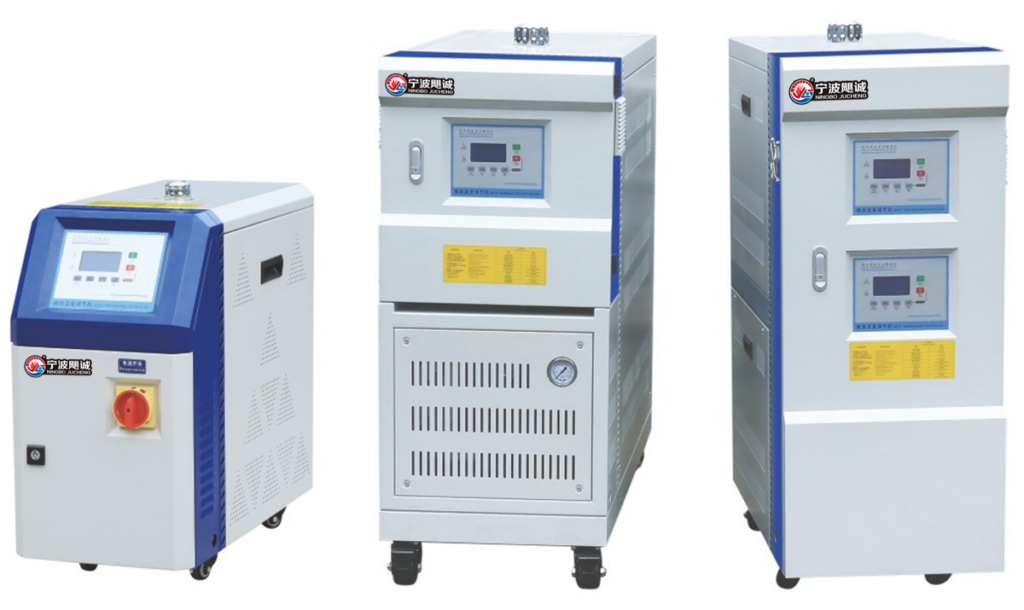
- High Temperature Control Accuracy
A mold temperature controller can control the temperature with an accuracy of within ±0.1℃. The temperature is also controlled uniformly and stably, significantly reducing the number of defective products in injection molding.
- Wide Range of Applications
Mold temperature controllers can be used in many industries/applications, such as heating molds in the injection molding industry; heating jackets in reaction vessels; temperature control for rubber mixers, internal mixers, and extruder heads; heating in chemical and dyeing industries; die-casting of aluminum and magnesium alloys; plastic/rubber industries, hot pressing, calendering, extrusion, vulcanization molding, artificial leather processing; metal industries, pickling, electroplating, coating, oil baths, heat treatment, etc.
In short, wherever temperature is involved in industrial production, mold temperature controllers are indispensable.
- Fast Heating Speed
Mold temperature controllers heat up quickly, reaching the desired temperature in just a few minutes. They have high thermal efficiency and low heat loss.
- High Yield Rate, Saving Raw Material Waste Costs
For example, when using nylon granules in injection molding, without a mold temperature controller to heat the mold, it might take dozens of cycles to produce a good product. However, with a mold temperature controller, a high-quality product can be produced in just two or three cycles, significantly reducing raw material waste costs.
- Wide Temperature Range
Mold temperature controllers have a wide temperature control range, capable of achieving virtually any desired temperature. Our mold temperature controllers are divided into oil-type and water-type. Water-type mold temperature controllers have a maximum temperature of 180 degrees Celsius, while oil-type mold temperature controllers can reach 350 degrees Celsius or even 400 degrees Celsius.